


On 11 December 2025, a regional webinar organised by EU4GreenRecoveryEast brought together more than 150 participants from the five Eastern Partner countries and beyond. Representatives of fellow projects, responsible ministries, agencies and wastewater sector utility operators joined the event to better understand both the 1991 Urban Wastewater Treatment Directive (UWWTD) and its newly adopted 2024 version, and to discuss how the commitments regarding approximation to this EU standard can be translated into local practice with support from EU4GRE.
A timely discussion for countries aligning with EU standards
The speakers highlighted that the implications of the UWWTD (1991) and its enhanced ambition (version 2024) require a stepwise alignment that should not be underestimated. For countries such as Ukraine and Moldova, currently engaged in implementing their alignment with the EU Acquis, the directive goes far beyond legal adjustments or upgrading existing wastewater collection and treatment. This refers to major capital investments, comprehensive (re)construction, increased operational costs, well-educated staff and substantial tariff reforms to ensure sustainable services.
On top, the revised UWWTD calls for long-term, realistic national strategies, covering:
- Planning for the next 10–20 years,
- Capacity-building and education programmes,
- Updated legal and technical guidance,
- Improved operation and maintenance standards,
- Stronger focus on issues like energy efficiency.
The webinar highlighted how past Directive implementation in EU countries proofed to be:
- Highly effective to remove pollution and improve water quality
- Highly efficient, as the benefits (27.6 B Euro/y) much exceed the costs (18 B Euro/y)
- Helpful for achieving objectives of other EU water directives (WFD, BWD, DWD)
- Supportive for the water management sector, with strong companies and new jobs
The webinar emphasised a clear message: the costed benefits of implementing the UWWD clearly outweigh the costs, and meeting the requirements of the directive calls for a comprehensive national wastewater strategy, supported by an efficient monitoring and information system, beyond infrastructure investments.
Expert insights and regional perspectives
During the three-hour session, moderated by Alexander Zinke from Environment Agency Austria (UBA) , the participants heard key notes from partner experts from the EU funded programme:
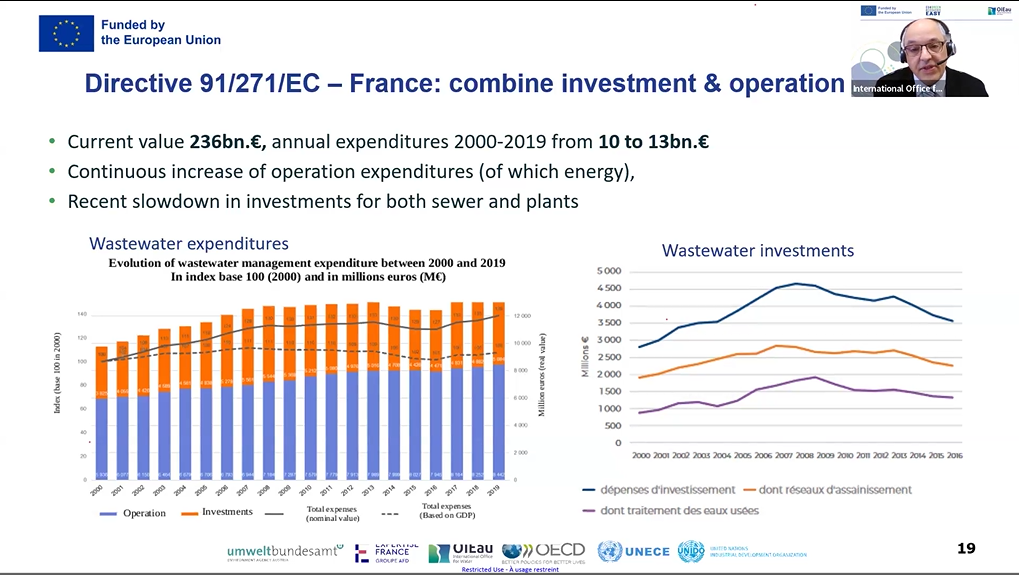
- Katharina Lenz (Environment Agency Austria, UBA) outlined the evolution of the old directive and shared practical insights into how EU member states approach compliance.
- Benoît Fribourg-Blanc (International Office for Water, OiEau) outlined the key elements of the new directive, presented the European information system making use of reported information to assess compliance. Fribourg-Blanc also presented the SIIF (“Structured Implementation and Information Framework for the Urban Waste Water Treatment Directive”) methodology and the associated online tool, which disclose the wastewater and compliance situation to a wide audience.
- Arsha James (UNIDO), representing the organisation leading the activities on wastewater treatment, presented progress to date and planned activities for the coming years. These include feasibility studies at selected pilot WWTPs, potential energy efficiency and recovery options, and related capacity-building activities.
Main topics raised by participants
The event included a Q&A session, where a number of participants posted questions and requested further insights about challenges, priorities and next steps related to the implementation of the UWWTD. This included technical questions on parameters or potential wastewater, re-use as well as requests for materials, guidance documents, or best practices. Participants also used the opportunity to fill in a Feedback Form, where they could list further requests and proposals.
Next steps: country-level follow-up
Building on the strong participation and interest, EU4Green Recovery East foresees national and regional follow-up activities to help countries develop or refine their wastewater strategies. While regional support programmes can assist in specific areas, national authorities will need to engage across ministries and sectors to meet the scale of the directive’s ambitions.
The webinar marks an important step toward stronger, more efficient and EU-aligned wastewater management across the region. By shedding light on the updated requirements and the scale of action needed, the event helped set the stage for more coherent planning and long-term investment in urban wastewater treatment that will be a major challenge.
Useful Links