



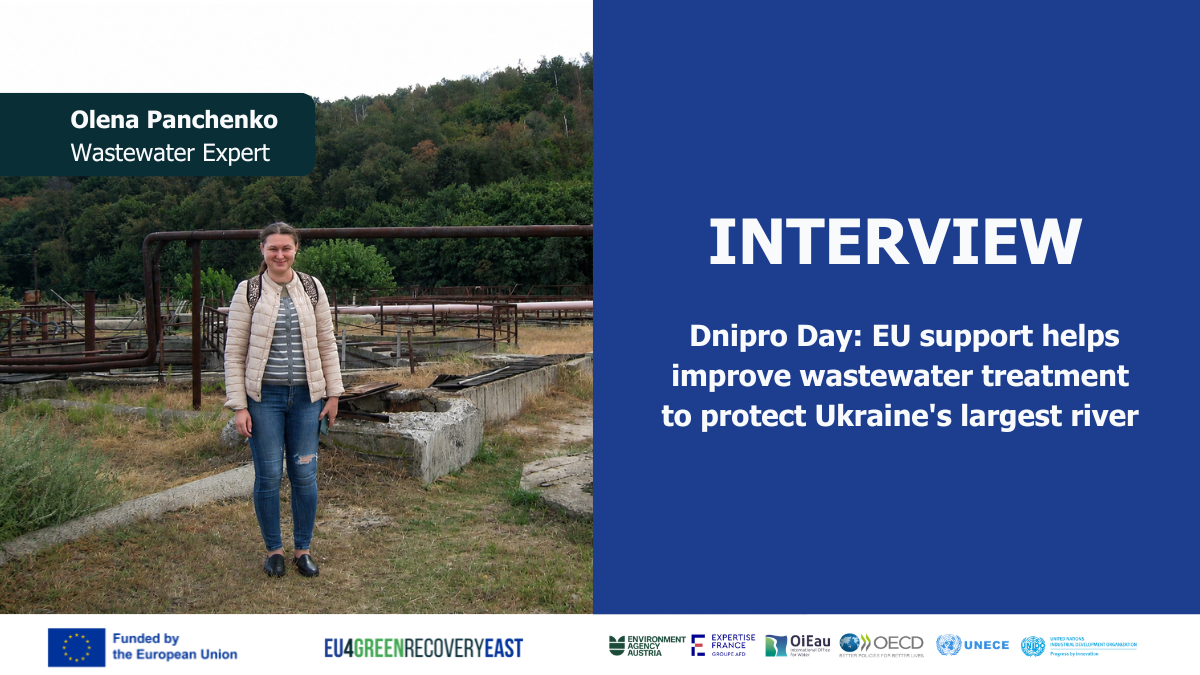
Every day, wastewater treatment plants protect rivers and public health, yet they often go unnoticed.
In Kremenchuk, where treated wastewater is discharged into the Psel River, a major tributary of the Dnipro, work is carried out with support from the European Union to assess the wastewater treatment plant's performance. This will help improve energy efficiency, strengthen sludge management and prepare future investments for the plant's modernisation.
We spoke with Ukrainian wastewater expert Olena Panchenko who is contributing to this work. She explains why wastewater treatment is essential for protecting rivers, how the sector continues to operate despite the challenges of Russia’s war of aggression, and why investing in more resilient and energy-efficient infrastructure is important for Ukraine's future.
The work in Kremenchuk is part of a broader effort under the EU4Green Recovery East programme to modernise wastewater treatment across the Eastern Partnership countries. In addition to Kremenchuk, pilot feasibility studies are being carried out at two other wastewater treatment plants in Ukraine and three in the Republic of Moldova. The goal is to make wastewater treatment more efficient and better adapted to climate change, as well as to reduce pollution in the Black Sea region. Read more.
Could you briefly introduce yourself? What inspired you to build a career in the water and wastewater sector?
My name is Olena Panchenko, and I work in the field of water supply and wastewater management, combining scientific research with practical implementation. At the Research Institute, I contribute to applied research and the development of technical solutions for the water sector, while also supporting international projects aimed at modernising water and wastewater infrastructure across Ukraine.
What inspires me most is the opportunity to bridge science and practice. Research helps us understand the challenges, while practical projects allow us to turn knowledge into real improvements for utilities and communities. Since the beginning of the full-scale war, I have seen even more clearly how essential resilient water and wastewater services are for people's safety, public health, and environmental protection. Contributing to the recovery and modernisation of this critical sector, and supporting Ukraine's alignment with European environmental standards, makes this work both meaningful and rewarding.
Many people rarely think about wastewater treatment. Why is it so important for protecting rivers like the Dnipro and for people's daily lives?
Wastewater treatment is one of those essential services that often goes unnoticed because, when it works well, people simply expect it to be there.
Across Ukraine, billions of cubic metres of wastewater are discharged every year into rivers and other surface waters. Without proper treatment, this can pollute rivers, damage aquatic ecosystems, and pose risks to public health. In Kremenchuk, treated wastewater is discharged into the Psel River, one of the major tributaries of the Dnipro. This means that improving wastewater treatment in Kremenchuk not only benefits the local environment but also contributes to protecting the wider Dnipro River Basin and the Black Sea.
During the war, maintaining wastewater services has become even more important. Damage to infrastructure and disruptions to electricity supply can quickly create environmental and public health risks. Wastewater treatment may be largely invisible, but it is one of the foundations of healthy cities, resilient communities, and healthy rivers.
Ukraine continues to improve its environmental infrastructure despite Russia’s war of aggression. What does it mean to work on wastewater projects during the war?
Working on wastewater projects during the war is challenging. Utilities continue operating under extremely difficult conditions, including damaged infrastructure, power outages, financial constraints, and constant security risks, while ensuring that essential services remain available to millions of people.
The war has shown that water infrastructure is not simply a public utility - it is part of Ukraine's critical infrastructure and national resilience. At the same time, Ukraine is looking beyond reconstruction. Rather than rebuilding outdated systems, the country is investing in modern, energy-efficient infrastructure that is more resilient to future challenges and aligned with European Union standards. Every wastewater project contributes not only to environmental protection but also to Ukraine's long-term recovery and European integration.
The assessment you are carrying out within the EU4Green Recovery East programme focuses on improving the energy efficiency of the Kremenchuk wastewater treatment plant. Why is energy efficiency particularly important for wastewater utilities in Ukraine today?
Wastewater treatment is an energy-intensive process, and electricity is one of the largest operating costs for most utilities. At the same time, much of Ukraine's water infrastructure was built decades ago and now requires modernisation, making energy efficiency one of the sector's biggest opportunities.
Today, this has become even more important because Russia’s constant aerial attacks are placing enormous pressure on the country's water supply and energy system. Energy-efficient wastewater treatment plants consume less electricity, reduce operating costs, lower greenhouse gas emissions, and are better fit to maintain essential services during periods of power supply disruption. Improving energy efficiency is therefore not only an environmental objective, it is also a key element of operational resilience and financial sustainability.
This assessment is the first important step as it provides a clear understanding of how the wastewater treatment plant currently performs and where further opportunities for improving energy efficiency can be found.
Once the assessment is complete, the EU4Green Recovery programme will support detailed feasibility studies. What are these studies designed to deliver, and how will they help Kremenchuk modernise its wastewater treatment plant?
The future feasibility studies will build on the assessment by quantifying investment needs, expected energy savings, and environmental benefits of several technical options.
They will also address one of the key challenges for many wastewater utilities in Ukraine: sewage sludge management. The feasibility studies will identify environmentally sound and economically feasible options for sludge recovery, reuse, or disposal in line with Ukrainian legislation and EU requirements.
Overall, the feasibility studies will help Kremenchuk prioritise investments, attract financing, and develop a realistic long-term modernisation plan, leading to a wastewater treatment system that is more energy-efficient, more resilient, and more sustainable.
If you could encourage one young person to join the water sector today, what would you tell them?
I would tell them that the water sector is a field where science, engineering, and public service come together to solve real-world challenges. Whether you work in research, design, utility management, or policy, your work has a direct impact on people's lives, on the economy, and on the environment.
Today, Ukraine needs a new generation of professionals who are ready to develop innovative solutions, apply new technologies, and help rebuild critical infrastructure. There are many opportunities to combine scientific research with practical implementation: from improving wastewater treatment processes and energy efficiency to supporting climate resilience and European integration. It is a career where your knowledge can create lasting, measurable benefits for both communities and the environment.
Credit pictures: Olena Panchenko
This document was produced with the financial support of the European Union by the partners of the EU4Green Recovery East consortium. The views expressed herein can in no way be taken to reflect the official opinion of the European Union or the governments of the Eastern Partnership countries. This document and any map included herein are without prejudice to the status of, or sovereignty over, any territory, to the delimitation of international frontiers and boundaries, and to the name of any territory, city or area.