


As a follow-up to the Green Agenda Armenia Conference 2026 in Yerevan, EU4Green Recovery East continues the discussion on one of Armenia’s key environmental priorities: improving air quality and strengthening alignment with EU environmental legislation under CEPA.
Air pollution is both an environmental and public health challenge, particularly in urban areas where road transport, construction, mining, industrial emissions and residential heating all contribute to pollution levels. In Armenia, improving air quality is therefore an important part of the country’s green transition and gradual approximation with the EU environmental acquis.
Through EU4Green Recovery East, the European Union supports Armenia in moving from legal approximation to practical implementation. This includes legislative gap analysis, legal drafting, monitoring systems, institutional capacity building, enforcement mechanisms and stronger coordination among authorities.
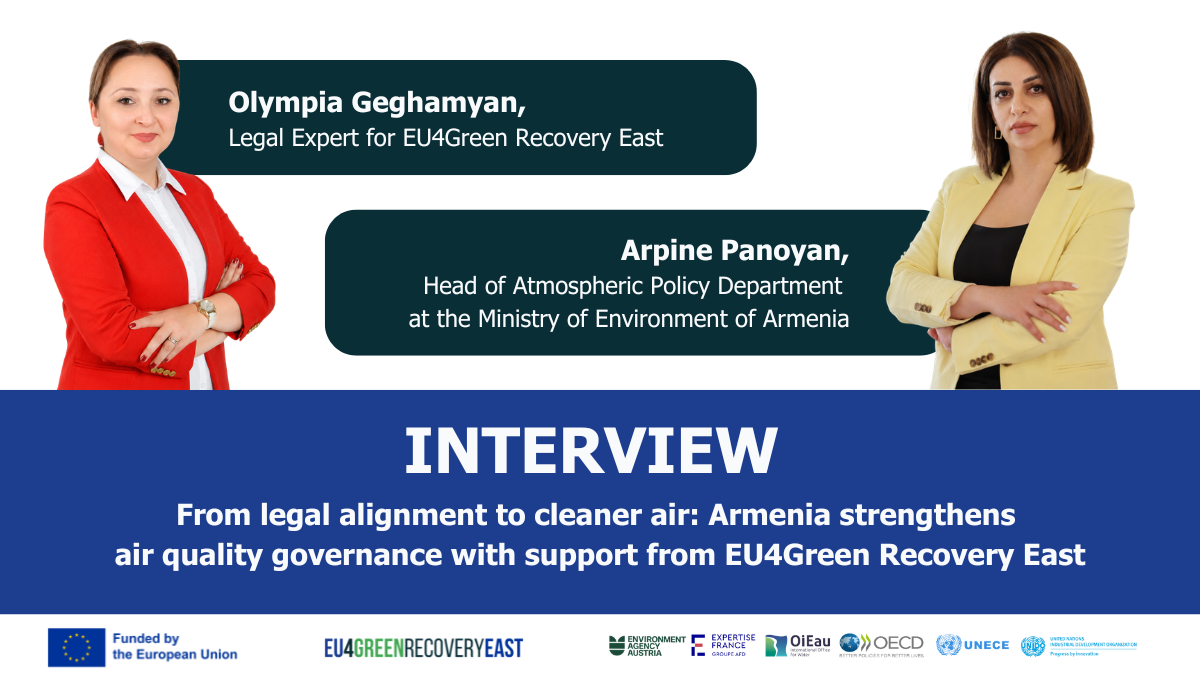
Following the Green Agenda Conference in Armenia, we spoke with Arpine Panoyan, Head of Atmospheric Policy Department at the Ministry of Environment of Armenia, and Olympia Geghamyan, Legal Expert for EU4Green Recovery East, about progress achieved under CEPA, remaining challenges and the role of EU support in strengthening air quality governance.
Air quality as a strategic priority
According to Arpine Panoyan, the protection of ambient air quality and the prevention of air pollution are among the strategic priorities of the Ministry of Environment.
“In Armenia, the main sources of air pollution include road transport, construction and mining activities, industrial emissions, as well as the use of various fuels for residential heating,” she explains.
Winter conditions can make the problem more serious, particularly in Yerevan, where temperature inversion can contribute to the accumulation of pollutants in urban areas. For this reason, the Ministry is placing strong emphasis on modernising the air quality monitoring system, expanding real-time data collection and strengthening the evidence base for policymaking. Armenia has already made important progress in aligning its air quality framework with EU standards under CEPA. A key achievement is the adoption of the 2025 - 2030 Action Programme on Air Protection, which provides a roadmap for improving air quality and advancing sectoral reforms. Armenia has also revised air quality assessment criteria, monitoring methodologies and requirements for monitoring stations, and designated agglomerations and air quality zones as a basis for targeted air quality management plans.
EU4Green Recovery East support under CEPA
EU4Green Recovery East has supported Armenia’s air protection reforms through structured technical and legal assistance. According to Olympia Geghamyan, this included a comprehensive gap assessment of Armenia’s Law on Air Protection and relevant Governmental Decision, followed by a reform concept and draft legal provisions aligned with the EU CAFE Directive 2024/2881.“This work directly supports Armenia’s gradual alignment with the EU environmental acquis under CEPA,” Geghamyan says. “It is not only a legal harmonisation exercise, but also a key step towards improving air quality governance, public health protection and institutional compatibility with EU standards.”
The programme also provided explanatory notes for lawmakers, particularly on emission permitting and control systems. This is important because approximation requires more than transposing EU rules into national legislation. It also requires institutions capable of implementing and enforcing those rules in practice.
From legal drafting to implementation
Both interviewees emphasise that legal approximation must be connected to implementation. For Armenia, this means modern monitoring infrastructure, stronger technical expertise, reliable data, effective permitting systems and enforcement capacity.
Panoyan notes that Armenia is working towards a national air quality monitoring network fully aligned with international and European standards. In 2025, two modern automated air quality monitoring stations were procured through state budget funding, and further expansion of the network is planned with support from national resources and international partners.
Geghamyan explains that one of the most complex aspects of approximation is the shift towards an EU-aligned regulatory approach based on Best Available Techniques (BAT), Emission Limit Values (ELVs) and integrated permitting.
“The most complex part of the approximation process lies in the transformation of the regulatory philosophy behind air protection,” she says. “Moving to a fully EU-aligned approach based on BAT, ELVs and integrated permitting requires not only legal drafting but also systemic redesign.”
This transformation affects emission permitting, monitoring, reporting, inspection and enforcement systems. It also requires careful sequencing to ensure coherence between existing legislation, newly adopted Governmental Decisions and future EU-aligned reforms.
Data, public information and trust
Reliable air quality data and public access to information are essential for effective environmental governance. Armenia has recently introduced new regulatory frameworks for state air quality monitoring, data collection, assessment and public dissemination. A key next step is the introduction of an Air Quality Index, which would make air quality information more understandable and accessible to citizens, including sensitive and vulnerable groups.
“Transparent and accessible information helps build public trust, encourages greater civic engagement and fosters shared responsibility for environmental protection,” Panoyan says.
Stakeholder engagement is also important for the success of CEPA-related reforms. As Geghamyan explains, air quality regulation is cross-sectoral and affects many actors, including institutions, businesses, municipalities and citizens. Clear communication can reduce misunderstandings, support implementation and build trust in environmental governance.
EU cooperation as a bridge to practical reform
Cooperation with EU-funded programmes such as EU4Green Recovery East plays an important role in Armenia’s approximation process. It provides access to European expertise, best practices and implementation experience, while supporting legislative drafting, institutional capacity building and coordination among authorities.
Panoyan notes that EU-supported programmes help ensure that reforms are not only aligned with the EU acquis on paper, but are also practical, implementable and sustainable in the long term.
Geghamyan describes EU4Green Recovery East as a bridge between the EU environmental acquis and Armenia’s legal reform process. Through approaches such as BAT-based regulation and integrated permitting, the programme helps adapt EU regulatory models to the Armenian legal and institutional context.
Towards cleaner air and measurable benefits
Successful implementation of Armenia’s air quality commitments under CEPA would mean a fully functioning air quality governance system in practice: modern monitoring, high-quality public data, stronger emissions control, targeted action on major pollution sources and better integration of air quality into sectoral policies and urban planning.
“The most important outcome would be tangible improvements in public health and quality of life,” Panoyan says. “If we succeed in ensuring cleaner air, reducing the health impacts of pollution and fostering more sustainable and greener urban environments, we can confidently say that our commitments have translated into real and measurable benefits for citizens.”
For EU4Green Recovery East, the next priorities include continued support for modernising industrial emissions regulations, strengthening emission permitting and control systems, improving monitoring, reporting and enforcement mechanisms, and supporting air quality planning and strategic roadmaps.
By supporting Armenia’s legal approximation, institutional strengthening and practical implementation efforts, EU4Green Recovery East is helping turn environmental commitments into concrete governance tools and, ultimately, into cleaner air and healthier communities.