


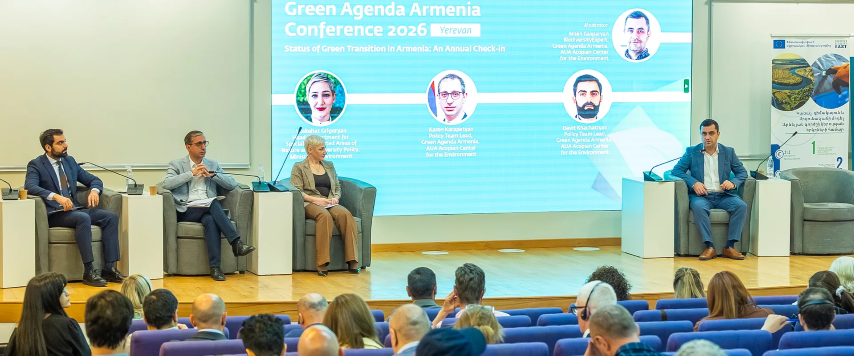
EU4Green Recovery East contributed to the Green Agenda Armenia Conference 2026 by highlighting how Armenia’s green transition can move from legal approximation with EU environmental legislation to practical implementation, enforcement and institutional ownership. Held at the American University of Armenia in Yerevan on 11 May 2026, the conference brought together government institutions, international organisations, EU-funded and donor-supported programmes, academia, civil society, the private sector and media to discuss Armenia’s progress in advancing its green transition agenda.
Organised by the Sweden-funded Green Agenda Armenia project, implemented by the Stockholm Environment Institute and the AUA Acopian Center for the Environment, in collaboration with EU4Green Recovery East, the conference provided an important platform to discuss how Armenia can move from policy commitments and legislative alignment towards practical implementation.
For EU4Green Recovery East, the conference was an opportunity to present the programme’s contribution to Armenia’s green transition across several priority areas, including legal approximation, water governance, air quality, circular economy, industrial waste mapping, environmental data and digitalisation. The programme’s participation across multiple sessions underlined that approximation with EU environmental legislation is not a stand-alone legal exercise, but part of a wider reform process requiring institutions, financing, enforcement tools, monitoring systems, communication and national ownership.
A central focus of the programme’s contribution in Armenia is legal approximation with EU environmental legislation, including relevant elements of Chapter 27 of the EU acquis. Under Component 3, EU4Green Recovery East supports partner countries in approximation, implementation and enforcement through legal gap analysis, legislative drafting, implementation planning, feasibility studies, enforcement and compliance systems, monitoring and reporting, capacity building and stakeholder coordination.
Speaking during the panel “Green Transition in Armenia and CEPA Alignment Priorities,” Josipa Križanović Cimeša, Component 3 Lead, explained that the programme is applying a step-by-step approach in Armenia, coordinated with the European Commission and linked to the broader EU integration and enlargement-oriented reform process.
She noted that Armenia has already made important progress in aligning with EU environmental legislation under CEPA, particularly through legislative gap analysis, policy development and stronger cooperation with the European Union. However, she stressed that the key challenge is now shifting from political commitment to practical delivery.
A concrete example presented at the conference was the programme’s support in the area of air protection. EU4Green Recovery East has completed a gap analysis of Armenia’s air protection legislation against relevant EU air quality directives and supported the revision of the new law on air protection, creating a basis for future legislative amendments and implementation planning.
“Approximation is not only about adopting the law. We can all have a legal framework, but if it is not implemented and if it is not realistic, then it just stays on paper,” Križanović Cimeša stressed.
The same panel also brought in the perspective of Armenia’s government coordination system. Astghik Hayrapetyan, Chief Specialist at the Department for Cooperation and Reforms in the Deputy Prime Minister’s Office, underlined that approximation is both dynamic and gradual. Armenia needs to keep pace with changes in the EU acquis, while also gradually adapting its own legislation, infrastructure and institutions.
“This is all about dynamic approximation. But there is another aspect, gradual approximation, when your infrastructure, your legislation and the state of play in your country shall be gradually accommodated to the developments,” said Hayrapetyan.
She also pointed to an important institutional challenge: many ministries and state institutions do not yet have dedicated units responsible for Armenia-EU cooperation, sectoral approximation and monitoring. This gap is particularly relevant for environmental approximation, where implementation requires coordination across sectors, agencies and levels of government.
Beyond the CEPA alignment panel, EU4Green Recovery East contributed to several other conference discussions directly relevant to Armenia’s environmental reform agenda.
In the opening thematic session, “Status of Green Transition in Armenia: An Annual Check-in,” Vahagn Tonoyan, Programme Representative in Armenia for EU4Green Recovery East, joined partners to review Armenia’s overall progress in the green transition and position the programme’s role in turning priorities into practical sectoral reforms.
EU4Green Recovery East was also represented in the session “Water and Green Transition,” where Tonoyan joined representatives of the Ministry of Environment, the Water Committee’s WISE project and GIZ EU4Sevan+ to discuss water governance priorities, progress and remaining challenges. The discussion was particularly relevant for the programme’s work on water resources and pollution reduction, as well as future implementation roadmaps related to EU water legislation.
Under Component 3, programme’s Armenia-focused legal and technical support was further reflected in the parallel session “Air Quality Management: Progress and Work Ahead.” Olympia Geghamyan, Legal Expert for EU4Green Recovery East, participated alongside representatives of the Ministry of Environment, the Hydrometeorology and Monitoring Center and Yerevan Municipality. The session addressed progress in improving air quality management, remaining policy and institutional gaps, and possible solutions, directly linking to EU4Green Recovery East’s support for air protection legislation and implementation planning.
EU4Green Recovery East also contributed to the parallel session “Circular Economy -Industrial Waste Mapping,” which presented circular economy activities under the programme and showed how practical tools can help businesses, regions and authorities identify circular economy opportunities, map industrial waste streams and support more resource-efficient practices.
In the session “Environmental Data and Digitalization,” the discussion addressed fragmented data systems, lack of unified standards, outdated legal frameworks, weak links between data and policy development, and uneven public digital literacy. These challenges are central to legal approximation because implementation and enforcement of EU environmental legislation require reliable monitoring, reporting and environmental information systems.
By contributing to discussions on CEPA alignment, water governance, air quality, circular economy, industrial waste mapping and environmental data, EU4Green Recovery East helped frame Armenia’s green transition as a practical reform process. The next step is to move from legislation on paper towards effective implementation in practice, supported by strong institutions, coordination, financing, monitoring systems, public trust and visible benefits for citizens.
For EU4Green Recovery East, this is where the programme can make a concrete contribution in Armenia: helping national institutions move from legal alignment to implementation, from technical reform to institutional practice, and from environmental commitments to measurable results.