


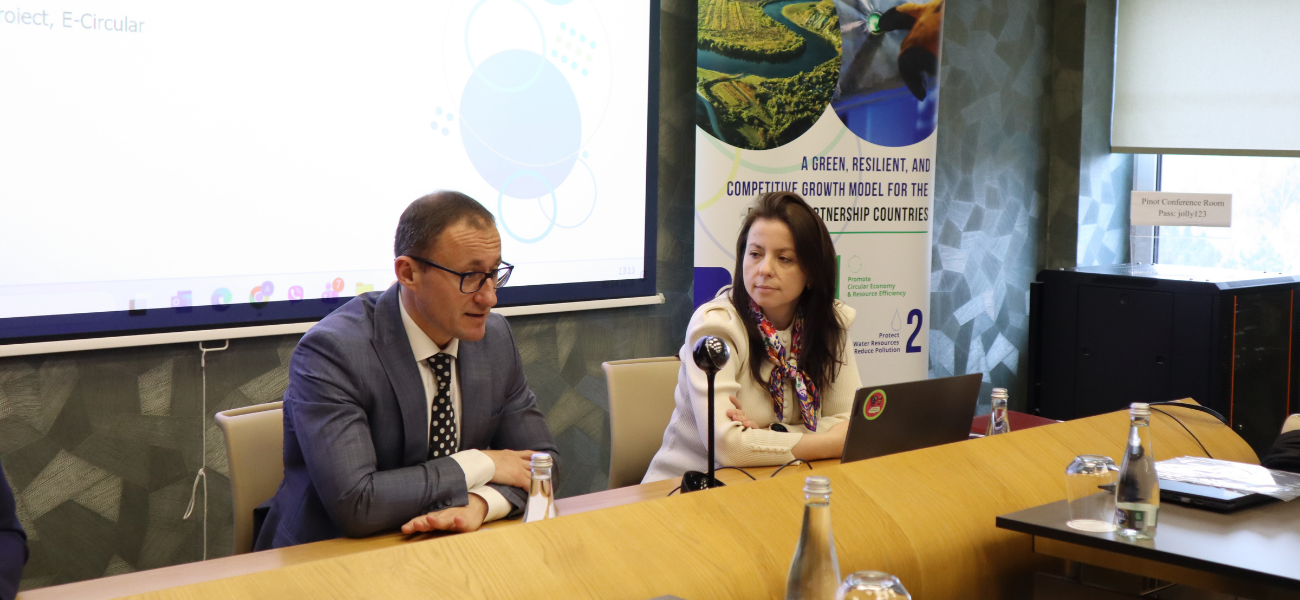
As part of the EU funded regional programme, EU4Green Recovery East, the United Nations Industrial Development Organisation (UNIDO) hosted a validation workshop in Chișinău to confirm priority sectors and regions for circular economy implementation in Moldova. The workshop brought together around 50 participants including government authorities, private sector leaders, and international partners to validate preliminary analysis and establish consensus on strategic priorities for the next phase of work under the programme.
Mr. Grigore Stratulat, State Secretary of the Ministry of Environment of the Republic of Moldova, emphasized the significance of the validation process in confirming national priorities for circular economy implementation and supporting the country’s transition towards resource-efficient and sustainable industrial development.
The validation workshop addressed a critical step in Moldova's transition toward more efficient and sustainable industrial development. By identifying priority sectors and regions, the workshop created the foundation for targeted interventions that can deliver concrete benefits to businesses and support the country's alignment with European environmental standards and EU integration goals.
Through structured analysis and stakeholder voting, priority industrial sectors were confirmed based on their circular economy potential, strategic importance to Moldova's economy, and feasibility for implementation. The methodology for sector screening and the ranking results derived from multi-criteria assessment were presented to participants. This analysis evaluated each potential sector against criteria including resource efficiency opportunities, waste generation patterns, market readiness, and alignment with national development priorities. Participants reviewed the analysis and provided their assessment using digital voting tools to confirm final priorities.
The confirmed priority sectors for circular economy implementation include, inter alia, the agri-food and beverages sector, textiles and garments, plastics, and construction.
In a second session, participants focused on selecting specific regions for industrial waste mapping activities. Proposed industrial areas had been pre-screened based on industrial concentration, waste generation patterns, local authority support, and readiness to engage with circular economy initiatives. The methodology for regional selection and preliminary ranking results derived from multi-criteria assessment were presented to participants. Using the same structured voting approach applied to sector selection, participants assessed the proposed regions and validated the final priorities for detailed analysis.
Chișinău and Bălți were confirmed as the priority regions for industrial waste mapping.
With these priorities confirmed, UNIDO will proceed with detailed industrial waste mapping in the validated regions and sectors, in collaboration with national service provider E-Circular. This mapping will identify specific opportunities for businesses to improve resource efficiency and reduce operational costs. The results will inform the design of demonstration projects and support evidence-based policy development at the national level.
The activity is implemented with the financial support of the European Union through the EU4Green Recovery East programme, which supports Eastern Partnership countries in advancing circular economy practices as a pathway to competitiveness and resilience.
Credit picture: E-Circular