


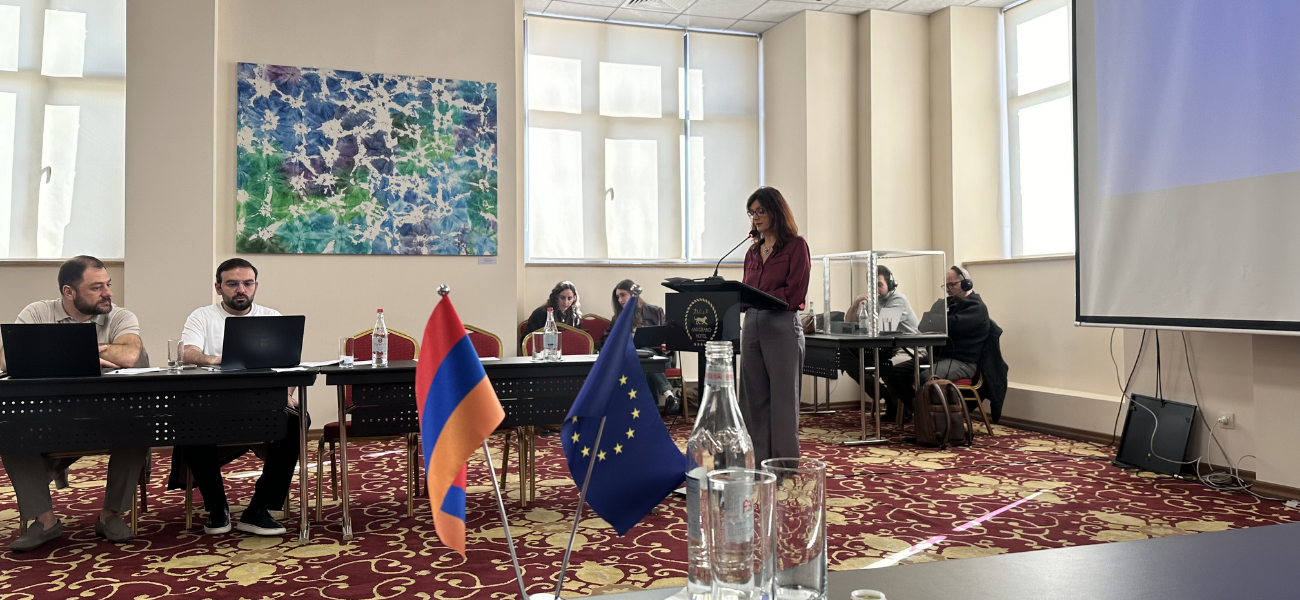
As part of the EU-funded regional programme EU4Green Recovery East, the United Nations Industrial Development Organization (UNIDO) convened two multi-stakeholder workshops in Yerevan on 1–2 April to support Armenia’s transition towards a circular economy.
Held on 1 April at the Ani Grand Hotel and on 2 April at the Ministry of Economy of the Republic of Armenia, the workshops brought together around 30 representatives each day from government institutions, the private sector, academia, civil society, and international organisations. Discussions focused on presenting and refining the priority regions and sectors identified for upcoming circular economy activities under the programme.
Priority regions identified for Industrial Waste Mapping
The first workshop focused on validating the results of a screening process used to identify pilot regions for industrial waste mapping (IWM) in Armenia. The event brought together a diverse group of stakeholders, including representatives from the Ministry of Economy, the Ministry of Environment, and the European Union Delegation, with opening remarks delivered by Susana Martins, International Aid and Cooperation Officer at the EU Delegation to Armenia. Participants reviewed the proposed prioritization of Yerevan, Kotayk, and Lori regions* for industrial waste mapping. Workshop attendees referenced the need to improve data accuracy and institutional coordination during the implementation phase of the project.
*edit from 30 April 2026: three regions were prioritised and two were finally selected: Yerevan and Kotayk.
Key outcomes of the discussions included the validation of the project implementation methodology and agreement on next steps for industrial waste mapping. Participants emphasized the importance of enhanced data integration, including linking environmental databases with tax reporting systems, and were introduced to a new analytical tool developed by the Ministry of Environment to track waste streams by region and type. The workshop also highlighted the need for continued stakeholder engagement at the regional level and confirmed strong commitment to support the next phase, including data sharing and sustained collaboration.
High-potential sectors selected for Circular Economy transition
The second workshop focused on validating the results of a sectoral screening to identify economic sectors with the highest potential for circular economy transition. Opening remarks were delivered by Lilya Sirakanyan, Deputy Minister of Economy of the Republic of Armenia, Susana Martins, International Aid and Cooperation Officer at the EU Delegation to Armenia, and Seda Kalantaryan, UNIDO Representative in Armenia.
Deputy Minister of Economy of the Republic of Armenia Lilya Sirakanyan said: “Circular economy is a strategic priority for the Ministry of Economy. We are dedicated to promoting a green and circular economy to foster sustainable development throughout Armenia."
The workshop presented the methodology and preliminary findings of the sectoral screening, which prioritized three economic sectors based on criteria such as material intensity, environmental footprint, economic significance, employment potential, and alignment with national policies and strategies. The three prioritized sectors, horticulture, tourism, and construction, were presented to participants for feedback and validation. These findings will guide the next phase of the project, including value chain analysis, identification of circular business models, and the development of targeted policy recommendations.
Together, the two workshops established a robust, data-driven foundation for advancing circular economy practices in Armenia. They also reinforced the importance of inclusive stakeholder engagement, transparency in decision-making, and sustained institutional cooperation to ensure effective implementation.
Credit picture: CIVITTA Armenia.