


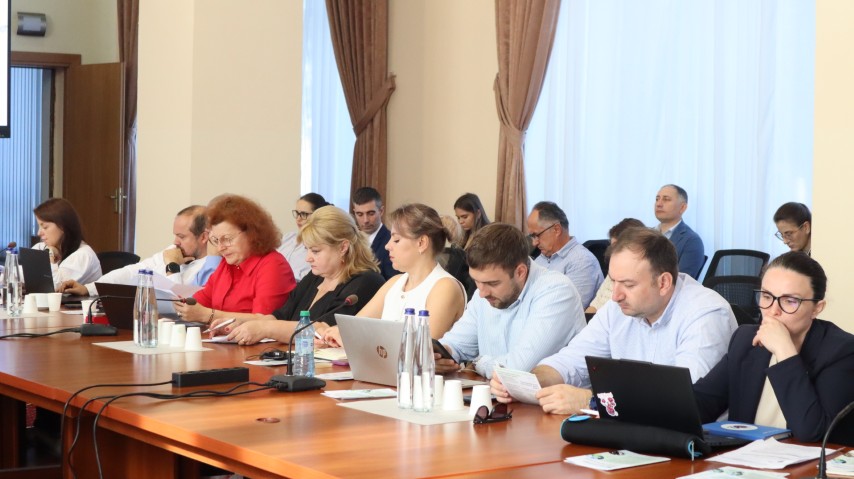
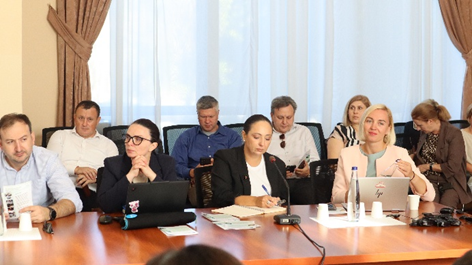
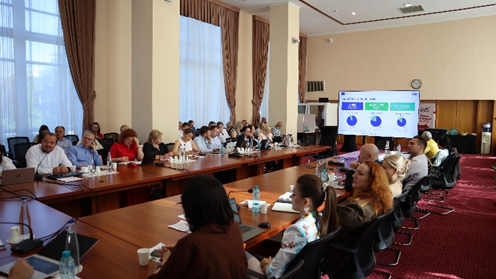
On 10 September 2026, the Inter-ministerial Working Group for promoting the Green and Circular Economy, Environment, Social and Governance (IWG GCE ESG) held its meeting in Chișinău to discuss industrial waste mapping, priority sectors and opportunities for advancing the circular economy in the Republic of Moldova.
The meeting was organised under the circular economy component implemented by the United Nations Industrial Development Organization (UNIDO) from the EU-funded programme EU4Green Recovery East. It brought together over 50 representatives from the Ministry of Economic Development and Digitalization, Ministry of Environment, public institutions, UNIDO, E-Circular and other partner organisations, to strengthen inter-institutional coordination and exchange on Moldova’s transition towards a green and circular economy.
Turning circular economy priorities into action – words from the room
Opening the meeting, Oleg Bivol, State Secretary at the Ministry of Economic Development and Digitalization, highlighted the importance of translating Moldova’s circular economy ambitions into practical tools for industry and entrepreneurship:
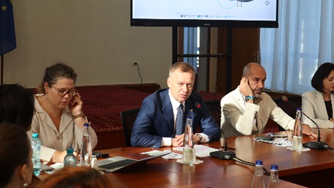 |
“We are here with a clear goal: to translate the circular transition from a strategic objective into concrete tools for industry and entrepreneurship. The value of these exercises is twofold: they allow us to base industrial development policies on real evidence rather than estimates, while also highlighting concrete opportunities for industrial symbiosis, where the waste of one enterprise can become a raw material for another, creating new business opportunities, jobs and a more resilient industry.” |
Gabriela Capcelea, Head of the Circular Economy Policies and Economic Instruments Section at the Ministry of Environment, emphasised the connection between the environmental and economic dimensions of the circular transition:
“For the Ministry of Environment, the transition to a circular economy is an important priority because it directly connects environmental protection, efficient use of resources and economic development. Industrial Waste Mapping and the analysis of priority sectors will help us identify which waste streams and products can be reintroduced into the economic cycle, where there is potential for the use of secondary materials and recovery of valuable components, and where new business models and green investments can emerge.”
Bruno Declercq, Delegation of the European Union to the Republic of Moldova, highlighted the strategic relevance of Industrial Waste Mapping for Moldova’s circular economy transition:
“Industrial Waste Mapping is, in fact, a strategic governance tool, not just a data collection exercise. It identifies waste sources, material flows, recovery pathways and opportunities for industrial symbiosis, helping to translate circular economy principles into concrete policies. From the EU perspective, such evidence can support policy development, prioritise interventions, improve resource efficiency and industrial resilience, and provide a basis for regulatory alignment, investment planning, sector prioritisation and institutional coordination.”
Industrial Waste Mapping as a basis for informed action
A central topic of the meeting was the Industrial Waste Mapping (IWM) exercise, implemented by UNIDO for the first time at national level, focusing on the municipalities of Chișinău and Bălți. Participants discussed findings and progress of the exercise and the ways in which the data generated through IWM can support evidence-based policymaking, prioritisation of interventions, resource efficiency and the identification of opportunities for industrial symbiosis.
Aligning circular economy and industrial development priorities
The meeting also focused on the four priority sectors identified for circular economy interventions, including the rationale behind their selection and the next analytical steps
- Agri-food and beverage
- Textiles and apparel
- Plastics
- Construction materials
Participants discussed potential synergies between these circular economy priorities and Moldova’s National Industrial Development Programme 2024–2028, emphasising the importance of aligning circular economy interventions with national industrial development priorities. The discussion also provided an opportunity to gather views on how the Hub could contribute to strengthening Moldova’s national circular economy ecosystem, improving coordination among relevant stakeholders and supporting the practical implementation of circular economy solutions in the Republic of Moldova.
Technology foresight for the circular economy, implemented under the programme, was also presented during the meeting. The presentation highlighted the key trends, drivers, and barriers influencing Moldova’s transition to a circular economy, based on the findings of a multi-stakeholder focus group conducted in July 2026. These insights will serve as the foundation for a scenario workshop to be held during the Circular Economy Conference in October.
| These findings will complement the Industrial Waste Mapping exercise by providing practical, enterprise-level information to support the identification of priority waste streams, resource-efficiency opportunities and potential circular economy interventions in Moldova. The meeting discussions were informed by field visits carried out on 8–9 September in Chișinău and Bălți. |
 |