


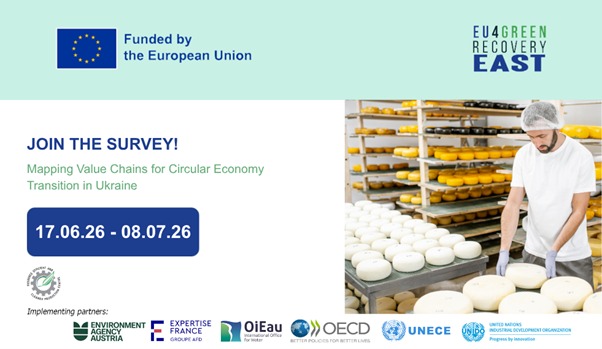
Within the framework of the EU-funded regional programme EU4Green Recovery East, implemented in the EU's Eastern Partnership countries, this survey marks the launch of a study on value chain mapping across three selected value chains in Ukraine: food, buildings and structures, and textiles. The questionnaire was developed by the Resource Efficient and Cleaner Production Centre (RECP Centre) jointly with UNIDO.
About the Survey
The survey collects structured data from enterprises, sector associations, and specialists to build an evidence base for circular economy diagnostics in Ukraine. It covers three value chains identified as priorities under the programme:
- Food – including agriculture, food processing, distribution, catering, and food and agricultural waste management;
- Construction and buildings – including resource extraction, production of building materials, construction, renovation, demolition, and waste management;
- Textiles – including fibre and yarn production, fabric and garment manufacturing, distribution, and waste management.
The survey consists of 30 general questions and up to 10 sector-specific questions. Only 8 questions are mandatory. Completing the survey takes approximately 20–30 minutes.
Why this matters
Ukraine is implementing a national transition to a circular economy. Mapping material flows, identifying inefficient use of resources and engaging enterprises in this process are necessary steps for developing targeted support measures and circular business models.
The survey results will feed directly into sectoral reports and form the basis for developing pilot projects for small and medium-sized enterprises (SMEs). Participants will be able to take part in follow-up interviews and working meetings.
What the survey covers
Across all three value chains, the survey asks respondents to share information on:
- company profile and position within the value chain;
- key inputs, by-products, and waste streams;
- current circular practices and assessment of their potential;
- main barriers to circular economy adoption;
- priority enabling conditions – including access to finance, digital tools, technical assistance, and training;
- circular business models in use or under consideration.
Each special module contains additional questions specific to the particular chain, for example, on stages of food loss and the valorisation of by-products for food; construction and demolition waste streams and barriers to recycling for buildings and structures; and textile waste management and fibre-to-fibre recycling in textile products.
How to participate
The survey is available online in Ukrainian and can be completed by 8 July 2026.
It is also possible to review all the questionnaire questions in advance in offline form. You may also submit the completed form to
Responses are confidential and will be used exclusively within the framework of this study. Participants who wish to be acknowledged in published materials may indicate their name and the name of their organisation.